 | Surgical Treatments for OsteoarthritisMost people with osteoarthritis of the knee won't require surgery. However, if you fail to see improvement with the conservative treatments, or your arthritis is causing you constant pain and/or interfering with your daily living your physician may recommend a surgical option. Knee surgery is generally used to relieve continual pain and inflammation, to slow down or prevent the destruction of your knee joint, or to restore the use and function of the deteriorated areas. Sometimes seriously damaged joints need to be replaced with artificial ones.  There are always some risks associated with any surgery, which include but are not limited to possible anesthesia reactions, thrombophlebitis (blood clots) infection, allergic reaction to medications, nonunion of the bones, loosening of the new parts, and damage to surrounding nerves or blood vessels. However, modern techniques have significantly minimized the occurrence of these problems. Although surgery is often successful at repairing damage and/or relieving pain, it does not necessarily return strength to your knee. Tenderness, pain, stiffness, scar tissue development and weakness are very common after surgery. This is why a strong commitment to rehabilitation utilizing the conservative treatments mentioned earlier is essential! Most of these surgeries will require rehabilitation utilizing conservative treatments. Rest and the application of a Cold Compress or Ice Pack can begin soon after surgery once the incision has healed up to quickly address post surgical inflammation. Your surgeon should provide a treatment plan to help you regain normal use as soon as possible. Healing and recovery time really depend on the degree of damage done to your knee, the type of surgery, your age, pre-injury level of function and your rehabilitation. Arthroscopic Surgery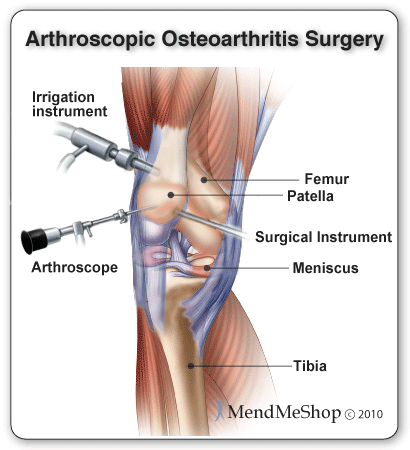 This surgery involves making tiny incisions around your knee joint and inserting a pencil-thin, fiber optic camera with a small lens and lighting system in one hole, and small surgical instruments in the other holes. The surgeon will take a look inside your joint to investigate all your soft tissues and bones. These images will then be transmitted to a TV monitor, which allow the doctor to make a diagnosis and/or perform the surgery under video control. At the end of surgery, your incisions are closed, and a dressing is applied. There are a number of different arthroscopic surgeries that can be performed to help relieve pain and inflammation in the early stages of osteoarthritis:
If you have arthroscopic surgery you will generally be under some type of anesthesia, most are completed in day surgery and do not require an overnight stay. Generally you will be able to your start rehabilitation soon after surgery and return to normal activities within 6 weeks - 4 months after surgery. These surgeries do not cure osteoarthritis of the knee, however they will permit you to maintain and participate in an active lifestyle. Although arthroscopic surgery has been a popular treatment for osteoarthritis, a study completed at the University of Western Ontario and the Lawson Health Research Institute in Canada challenges its effectiveness. In the study, published in the September 11, 2008 issue of The New England Journal of Medicine, researchers treated 2 groups of osteoarthritis patients with medication and physical therapy. 1 of these groups also underwent arthroscopic surgery. Patients of each group reported comparable improvements in pain, movement and function suggesting surgery had no additional therapeutic value over non-surgical methods. Although arthroscopic surgery may be useful for patients with ACL or meniscal tears, researchers recommend osteoarthritis patients pursue conservative treatment methods before resorting to surgery. Tibial OsteotomyUndergoing Tibial Osteotomy surgery involves:
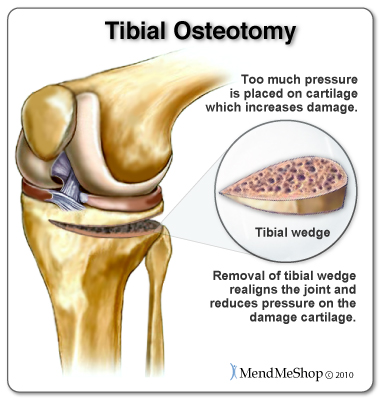 In both surgeries a pin is used to bring the edges together, and the leg is placed in a padded splint. A tibial osteotomy is considered a major surgery that requires a walker or crutches, stitch removal after 2 weeks, a brace for approximately 6 weeks and extensive rehabilitation. The goal of this surgery is to shift the pressure on the cartilage from the damaged side to the healthy side of the knee, with the hope that the new positioning will help your cartilage regenerate and grow. Tibial Osteotomies are performed to reduce pain and delay degeneration of the knee joint. It is often recommended for people under 60 years of age who want to maintain an active lifestyle, or those who have osteoarthritis on only one side of their knee. It is recommended for those who suffer from bowleggedness or knock-knees. It is not always a successful surgery, however it generally allows you to buy time before a total knee replacement (lasts about 5 - 7 years). Knee Replacement SurgeryThere are 2 types of knee replacement surgery:
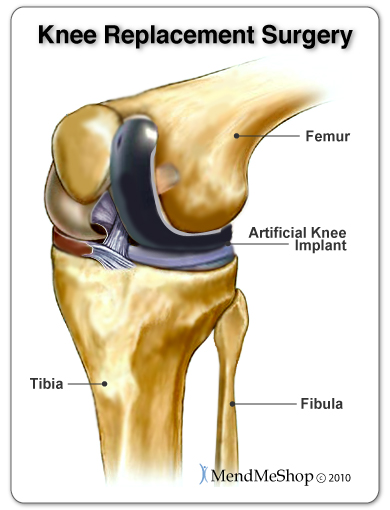 A partial or full knee replacement is considered a major surgery that requires anywhere from a few days to a few weeks in the hospital, followed by minimal weight-bearing for 5-6 weeks, and an intensive rehabilitation period. It helps to relieve discomfort and improve your movement, permitting you to live a more active life. It is used on patients who have exhausted other treatment types and suffer from advanced stages of osteoarthritis. It is most recommended for people 60 years or older, who will participate in low impact activities like swimming, biking, golfing and/or walking. It is not generally recommended for younger patients or those who participate in active and impact loading sports like skiing, basketball, squash, jogging or impact aerobics. These activities tend to put too much stress on the artificial joint causing it to loosen and/or crack; in turn requiring revision surgery to fix the damage. Once you have a knee replacement, talk with your physician about our Knee TShellz Wrap® products to see if they should be a part of your knee replacement surgery rehabilitation. Knee Fusion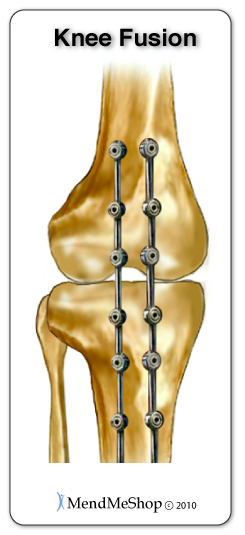 Knee Fusion (Arthrodesis) is a salvage procedure that is often used after a failed total knee replacement and/or if a knee replacement can't be done. It involves cutting off the bony ends of the femur and tibia, and stripping out the ligaments, menisci and synovial joint lining so that the 2 bones can be fused together with pins, plates or screws in a straight position (with a slight bend). The hope is that the ends of the bones will eventually grow together. It is another major surgery that requires extensive rehabilitation. Your surgeon or physical therapist may find the Circulatory Boost to be a very effective tool during post surgery rehabilitation. to see if they should be a part of your knee replacement surgery rehabilitation. This surgery provides a stable and pain-free, though stiffer and shorter leg; most people will be able to bear weight better, however they will walk with a slight limp. The success of this surgery is really dependent on your bone stock, your age and your health prior to surgery. Generally surgeons prefer to perform this surgery on younger and/or more active individuals; although it is not used as frequently as in the past. Knee Surgery RecoveryIf you have had or will be having knee surgery, remember that proper post-surgery rehabilitation is very important, perhaps even more important than the surgery itself. Activities should set out to promote healing, increase flexibility in the knee and strengthen surrounding muscles. An important point for knee osteoarthritis patients to remember after surgery is that every effort must be made to increase strength in the knee joint. Weakness in the knee can usually be eliminated by extra strengthening exercises, but increased stiffness can become a problem if physical therapy and specific therapies to stimulate blood flow (such as the Knee TShellz Wrap® are not done. Just be sure to talk with your therapist before beginning any knee stretching routine to ensure it is the right time to start. Not only will a Cold Compress or Ice Pack help reduce pain and inflammation in your knee, but incorporating the Knee TShellz Wrap® in your treatment plan will help increase the range of motion in the knee joint, boost blood flow in the treated area (to accelerate recovery) and reduce post operative scar tissue. Talk with your physician about our simple therapy recommendations to see if they should be a part your osteoarthritis treatment regimen. As with all medical devices, make sure your physician is aware of any treatment plan you decide to take.  To prevent further deterioration in your knee joint, it is recommended that you gradually increase the intensity of any exercise or activity when you begin and to be aware of the movement of the knee during activity. A knee that is supported by strong leg muscles is less prone to injury and deterioration because there is less load on the knee. If your knee is unstable or weak, wearing a brace during exercise and activity can reduce the pressure on your knee joint and reduce your pain and inflammation.
Product Advisors are available 9:00 am to 5:00 pm Eastern Standard Time Monday to Friday. Learn More About Knee Injuries & TreatmentsI want to learn more about post-surgery recovery. I want to learn all about common causes of knee pain. I want to learn more about TShellz Wrap® Circulatory Boost I want to learn more about Ice & Heat: Which Is Better For Treatment? I want to learn more about Knee Treatments. I want to learn more about Runners Knee. I want to learn more about Hoffas Syndrome. I want to learn more about Knee Arthritis. I want to learn more about Knee Trigger Points. FREE SHIPPING ON ALL PRODUCTS CURRENTLY ENABLED |
    |