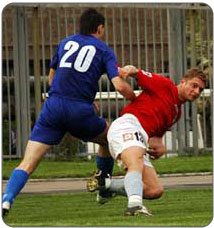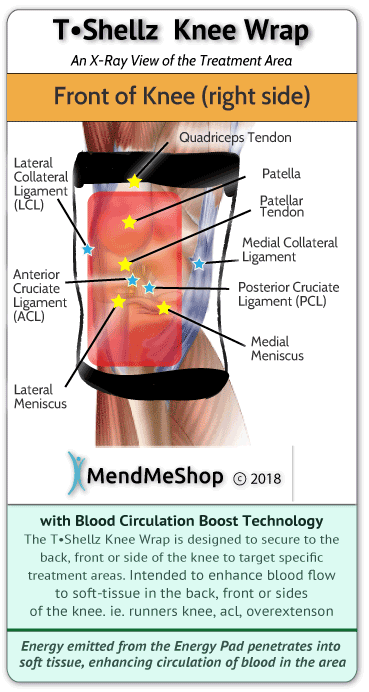

Hoffa's Syndrome (Fat Pad Impingement)Your Hoffa's pad (infrapatellar fat pad) is a fatty pad that sits below your patella (knee cap) directly behind your patellar tendon. It cushions the patella, preventing it from hitting against the condyle of your femur (or end of the thigh bone) in the case of a direct blow to the front of the knee. The fat pad in the knee has a lot of nerve cells, so any injury to it is extremely painful. ![]() Hoffa's Syndrome is a condition in which the infrapatellar fat pad either suffers a contusion or an injury, resulting in damage and swelling. This can lead to the Hoffa's pad becoming trapped between the femur and the patella every time the leg is extended. Fat pad impingement can also occur if the fat pad is pinched when the leg turns inward abnormally while running. The risk of this happening increases if you have instability in your knees or hips which can be a result of other conditions such as Achilles injuries. When favouring a sore Achilles tendon in one foot, you begin to use improper mechanics to walk or run and this can lead to unbalanced loads and over straining one of your knees and/or hips. Because straightening the leg will cause the fat pad to become trapped, it is being re-injured constantly and can lead to a significant recovery time if not treated quickly and correctly. Hoffa's Syndrome Causes![]()
Fat Pad Impingement Symptoms
Hoffa's Syndrome TestYour doctor or health care professional will examine your knee to determine if you have Hoffa's Syndrome (fat pad impingement). He/she will ask you to lie down with a bent knee. You then slowly straighten your leg while the doctor presses his or her fingers below the knee cap (patella), on either side of the patellar tendon. Any pain or hesitation when straightening the leg is considered a positive test for Hoffa's Syndrome. Treating Knee Pain - What You Can Do!Allowing your knee to rest is always recommended when you are suffering from fat pad impingement. Avoid activities that may have caused the injury or irritation and begin cold compression treatments as soon as possible. It is difficult to rest your knee completely as you have to get on with your daily activities. Fortunately, there are healing tools that can help treat your pinched fat pad and speed up the healing process so you can get back to a life without pain and risk of further injury. Therapeutic ultrasound and Blood Flow Stimulation Therapy™ (BFST®) will treat scar tissue and promote blood flow to heal your knee faster and more completely than any other methods available. Cold Compression TherapyUsing cold compression immediately following an injury reduces pain, swelling, and tissue damage that occurs when you have Hoffa's Syndrome (fat pad impingement). The Knee Freezie Wrap® allows you to treat your knee in an effective and convenient way to rid yourself of the pain of Hoffa's Syndrome at the front of your knee. Cold Compression Therapy works by interrupting and slowing nerve and cell function in the damaged area. This is important because once blood vessels are damaged, they can no longer carry oxygenated blood to the infrapatellar fat pad and patella tendon and tissue cells begin to break-down. The deep cold provided by the Knee Freezie Wrap® slows cell function thereby reducing cellular break-down. Furthermore, because the cold wrap serve to numb the nerves, the wrap also reduces pain! The Knee Freezie Wrap® uses a deep cold gel pack with a medical-grade neoprene compression cover to keep the ice off the skin preventing cryoburn and surrounding your knee cap with soothing cold. Ultrasound TherapyUltrasound Therapy increases tissue elasticity while promoting the flow of blood (filled with vital oxygen and nutrients) to your infrapatellar fat pad and patella tendon. This cleans the injured area by getting rid of damaged tissue and reducing the inflammation, opening up the blood vessels to begin healing. During the healing process, scar tissue builds around the infrapatellar fat pad and can attach it to the patella tendon, quadriceps tendon, tibia, femur, or other surrounding tissue in the joint, limiting the flexibility in your knee. Fortunately, you can treat your impinged fat pad with therapeutic ultrasound to soften scar tissue and improve your range of motion. Not only does ultrasound aid in the duration of healing, but it helps to prevent long term complications. Pain, scar tissue, lack of mobility and arthritis are some of the more common long term complications from Hoffa's Syndrome. By treating your fat pad with ultrasound, scar tissue is softened reducing the risk of chronic problems in the future. For those who suffer from long term complications of fat pad impingement or other knee injuries like ACL or meniscus tears, ultrasound can help. With dedication to your ultrasound therapy you can soften the tough and inelastic scar tissue that has built up in the affected area. Ultrasound can also be used to administer therapeutic medicines into the body. This is a process known as phonophoresis. Ultrasound with phonophoresis is rapidly becoming more popular than ultrasound therapy alone. Phonophoresis can be received using a MendMeShop® Ultrasound Therapy System. The treatment is safe, easy, painless, and generally requires between 5 - 10 minutes. Using MendMeShop® Lavender Infusion Ultrasound Gel during your therapy gives you 2 therapies in 1. You get the benefit of the regenerating sound waves from the ultrasound device itself AND the added bonus of the therapeutic ingredients inside the gel being delivered into the tissue where it is most effective. MendMeShop® Lavender Infusion Ultrasound Gel comes with every MendMeShop® Ultrasound and it contains the therapeutic essential oils of natural Bulgarian lavender, peppermint, eucalyptus, and menthol. Once the inflammation and swelling of Hoffa's Syndrome has been alleviated, nourishing and strengthening the tendons and surrounding tissue in the knee is recommended. Using Blood Flow Stimulation Therapy™ will speed your recovery and heal your soft connective and muscular tissue more completely, preparing it for leg strengthening exercises. Talk to your doctor or physical therapist to find out which exercises are appropriate for your situation. Blood Flow Stimulation Therapy™After the inflammation and swelling behind your knee cap and around your patellar tendon is gone, you can begin to treat your entire knee with Blood Flow Stimulation Therapy™, or BFST®. BFST® increases the amount of blood that flows naturally to your knee to nourish your fat pad, meniscal cartilage, tendons, ligaments and muscles to speed healing. By treating yourself with Blood Flow Stimulation Therapy™ you can increase your body's blood supply to the knee and your body's natural healing power. In addition, the fresh blood flow whisks away dead cells and toxins that have built up from the tissue damage of Hoffa's Syndrome leaving the area clean and able to heal faster. Our Knee Inferno Wrap® provides the most effective, non-invasive, non-addictive pain relief and healing with no side effects. During your recovery, you will probably have to modify and/or eliminate any activities that cause pain or discomfort in your knee until your pain and inflammation settle. Taking the time to care for your knee properly will have your knee back to normal faster and allow you to get back to the activities you enjoy. With these 3 easy therapies you will notice incredible results in your knee. The more diligent you are with your treatment and rehabilitation, the faster you will see successful results! We recommend that you consult your doctor and/or physiotherapist before using any of our outstanding products, to make sure they're right for you and your condition. | Some Facts About Knees: Approximately 19.4 million visits to physicians' offices in the US per year are due to knee problems. The knee is a complex joint with many components, making it vulnerable to a variety of injuries. Oral medications can mask the pain but do not aid in the healing of knee injuries. Most knee injuries can be successfully treated without surgery. Sadly, regardless of treatment, ACL injuries in high-school youths are associated with a 10-fold increased risk for degenerative knee arthritis later in life. Every year, at least 1 in 3000 Americans between ages 14 and 55 tear an anterior cruciate ligament (ACL). ![]() ![]() ![]() ![]() ![]() ![]() ![]() ![]() ![]() |