  | Prepatellar BursitisCauses of Patellar Bursitis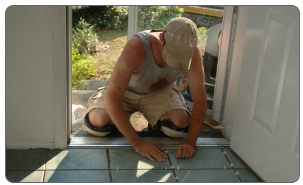
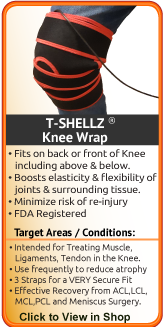
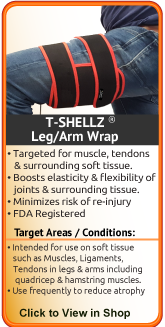
Symptoms of Patellar BursitisPainBursitis in the prepatellar bursa results in pain on the middle part of the knee and over the patella. The pain may radiate up your inner knee and thigh and/or down to your midcalf. Those who suffer from prepateller bursitis complain of increased pain when crossing their legs or when rising after sitting for several hours. Due to the location of the bursa, pain will make kneeling difficult. Bursitis pain becomes worse during exercise or when you are climbing stairs, but can also increase by simply bending and straightening your knee. Pain usually starts gradually and develops over a few days or even months. Tenderness, Warmth, Swelling and RednessSwelling is usually evident with prepatellar bursitis and often appears as an abscess on the kneecap. This swelling may appear immediately following trauma, over a couple of hours, or up to 7-10 days after the event that caused the irritation.  You will experience tenderness just below and over top of the kneecap with prepatellar bursitis. You may also notice warmth and visible redness on your skin in the area as inflammation in the bursa and along the tendons becomes more severe. Difficulties SleepingPatients suffering from knee bursitis may also have interrupted sleep patterns. Simply bending your knee or rolling over during sleep can cause pressure on the inflamed bursa, increasing your pain. The pain can range from mild to very sharp depending on the amount of inflammation in your knee. Many knee bursitis sufferers recommend placing a pillow between your knees/thighs while you sleep to reduce pain throughout the night. Limited Range of Motion and WeaknessWhen you have bursitis in your knee, the pain is often limiting as you stop performing motions that make the pain worse. If bursitis is left untreated the inflammation can increase, causing more pain, limiting movement even more and eventually weakness in the leg muscles and tendons can set in. As you lose strength in your quadriceps, your legs may begin to give out during daily activities. It is important to treat bursitis in the early stages to reduce the symptoms, minimize damage and maintain motion and strength in your knee. Eliminate any squatting, repetitive knee bending, crossing your legs, kneeling or any other activities that add pressure on your bursa. By treating your knee bursitis in the early stages with a Cold Compress or Ice Pack and a Knee TShellz Wrap® (once swelling has reduced), you are more likely to prevent long-term damage and chronic conditions from setting in. Treatments for Patellar BursitisRelieving the symptoms of bursitis initially focuses on keeping the pressure off the bursa. If your bursitis is caused by an infection (septic bursitis), the doctor will probably drain the bursa sac with a needle and perscribe antibiotics to treat the infection. For non-infectious bursitis, the preliminary treatment starts with conservative treatments, which is what the TShellz Wrap® is made for..  The most important factor in healing bursitis is resting your knee. This can be difficult when you have to carry on with daily activities, but resting whenever you can is recommended. During your recovery you will probably have to modify or avoid the activities that stress your bursa until your pain and inflammation settle. Treatments should involve decreasing swelling, relieving stress on the knee, treating scar tissue, and then restoring strength and movement in your leg and knee. Circulation Boost (Circulatory Boost) is recommended once inflammation has been calmed to increase blood flow - resulting in accelerated healing of the bursa and surrounding soft tissue while reducing the risk of reinjury. Cold TherapyTo decrease inflammation and relieve the pain of prepatellar bursitis doctor's recommend cold therapy. Applying cold to your inflamed bursa will help decrease the swelling and redness around it. Cold therapy will also help to numb the pain in your knee and help to control the inflammation. Cooling your inflamed prepatellar bursa as needed throughout the day will reduce pain and tissue damage. Applying cold to your tender bursa and knee is the first step in treating your bursitis. Once inflammation has started to subside (and some of the pain) begin use of the TShellz Wrap® to continue and boost the healing process. TShellz Wrap® & Circulation Boost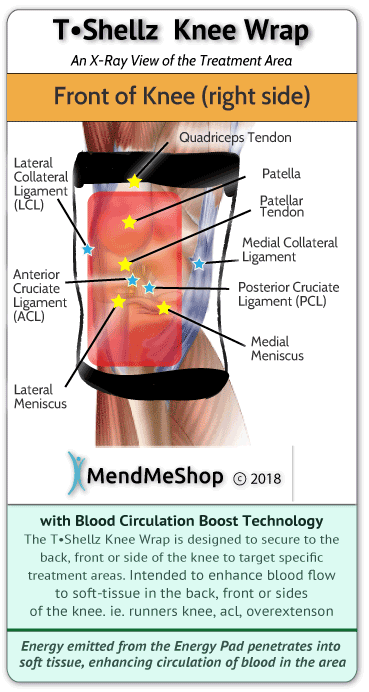 Unfortunately, when you are suffering from bursitis it can be painful to even walk or lift your leg. When you limit movement in your knee joint the blood flow is reduced, starving your tissue of the necessary oxygen and nutrients. The trick is to find a way to increase blood flow without causing pain and/or further inflaming the bursae. This is where the TShellz Wrap® becomes a powerful tool. Circulatory Boost compliments your body's natural healing process by promoting blood flow while you give your knee the rest it needs. Energy emitted from the Energy Pad stimulates blood circulation in your knee, more than your body would ever be able to generate on it's own, giving your body the boost in blood flow it needs to continue the reconditioning process. This enhanced blood flow helps speed tissue repair, whisk away toxins and dead tissue, and rejuvenates soft tissue for improved elasticity. With these easy therapies- cold compression and TShellz Wrap® treatments, you will notice significantly reduced pain and an incredible improvement in your knee pain and range of motion. We recommend that you consult your doctor and/or physiotherapist before using any of our outstanding products, to make sure they're right for you and your condition. Anti-Inflammatory MedicationsNSAIDs, non-steroidal anti-inflammatory drugs, can be used if required to help manage your pain and reduce inflammation. However, they aren't recommended for long term use, as they can cause gastrointestinal difficulties and increase the risk of cardiovascular disease. The use of cold therapy and Circulatory Boost in conjunction with NSAIDs can greatly reduce healing time and reduce the amount of medication you take. Surgical ProceduresYour doctor may aspirate your inflamed bursa. This involves removing the extra fluid that has built up with a needle. Sometimes, the fluid will be tested at a laboratory to rule out infection. If your bursitis does not get better with conservative treatments, the bursa may be surgically removed. Usually this is done by arthroscopic surgery, which is a surgical procedure where tiny incisions are made and a pencil-sized camera is inserted into the knee. A small shaver is inserted into another incision, and is used to remove the swollen bursa all together. The surgeon will then look for any damage to the knee and make repairs if necessary. Although this does eliminate the pain of bursitis, it greatly increases the risk of osteoarthritis in the knee.  Recovery time for the surgery will depend on a number of different factors including your healing ability, diet, rest and how many procedures were done in your surgery. Post-op recovery time can be reduced with the use of cold compression Circulation Boost following surgery. Cold compression is recommend by doctors following surgery to treat your pain in a natural, non-addictive way and to reduce swelling. Once the incision has healed, speak with your doctor about the use of T_BL00D. Circulatory Boost encourages more oxygen and nutrients to flow to the area to speed healing and improve the strength of the soft tissue in your knee. Using Circulatory Boost as soon as your incisions have healed will work on reducing the growth of scar tissue that forms from your surgery and help the elasticity of the soft tissue around the surgery site. Treating scar tissue is the most important step following surgery, especially in a joint, to improve the range of motion in your knee. Leaving the scar tissue untreated can lead to stiffness, chronic knee pain, osteoarthritis or other knee conditions. Rehabiliation ExercisePT is a beneficial way to restore atrophied muscles and improve strength and mobility after treating bursitis. The type of PT and the duration will be dependent on the tissue damage and your symptoms. When you are treating or recovering from bursitis, it is important to ensure you do not perform any exercises that will further irritate the bursa. 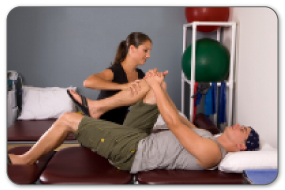 Once your pain starts to diminish, a physiotherapist will set up an individualized strengthening and stretching exercise program for you to perform at home or in the gym. This will be based on your needs and abilities, and will help you return to performing your normal routines. Individuals will often lift weights on their own, to try and build up their strength. However, in doing so, they can do more damage to the weak knee. It is extremely important to strengthen your muscles properly. A trained therapist will help to ensure your rehabilitation process is appropriate and effective. For best, long term results use Circulatory Boost in conjunction with PT and an exercise program.  During your recovery, you may have to modify and/or eliminate any activities that cause pain or discomfort in your knee joint until your pain and inflammation settle, and you gain more mobility and strength. The more diligent you are with your rehabilitation, the faster you will see successful results. Product Advisors are available 9:00 am to 5:00 pm Eastern Standard Time Monday to Friday. Learn More About Knee Injuries & TreatmentsI want to learn more about post-surgery recovery. I want to learn all about common causes of knee pain. I want to learn more about TShellz Wrap® Circulatory Boost I want to learn more about Ice & Heat: Which Is Better For Treatment? I want to learn more about Knee Treatments. I want to learn more about Runners Knee. I want to learn more about Hoffas Syndrome. I want to learn more about Knee Arthritis. I want to learn more about Knee Trigger Points. FREE SHIPPING ON ALL PRODUCTS CURRENTLY ENABLED |
      |